Dealership SEO Pages That Should Turn Search Into Leads
Dealership SEO works better when pages are mapped to buyer intent, not just keywords. These are the pages I would review first.
Dealership SEO should not be treated like a generic blog plan. A dealership does not need random articles that sound busy but never help a buyer choose a vehicle, request financing, schedule service, or submit a lead. The goal is to help real buyers find the right page, understand the offer, trust the dealership, and take the next step without getting lost. That means the best dealership SEO work starts with page mapping, not just keyword lists.
What dealership SEO should answer first
When someone searches for a dealership, they are usually not looking for entertainment. They want an answer, a vehicle, a price range, a location, financing options, trade-in information, service help, or proof that the business is real. Good car dealership SEO connects those search moments to pages that can convert. If the page only repeats a keyword but does not answer the buyer's real question, it may get impressions without producing useful leads.
For Jerome SEO Works, the focus is simple: build search visibility around pages that can support lead flow. That includes classic SEO signals like crawlability, metadata, headings, internal links, content structure, and Google Search Console review. It also includes practical conversion details like forms, calls to action, inventory paths, and follow-up context. If this is the kind of work your site needs, the dealership SEO service page explains how I review those priorities before recommending new content.
Start with dealership pages closest to revenue
Before adding more content, I would review the homepage, inventory or category pages, financing pages, trade-in pages, service pages, location pages, and lead capture pages. These pages sit close to revenue because they match the questions buyers ask before contacting a dealer. They also create strong internal-link targets for supporting blog posts, FAQs, service pages, and campaign landing pages.
- Homepage: clarify the dealership type, market, trust signals, primary vehicles, location, and main actions such as view inventory, get approved, value trade, or contact the team.
- Inventory or category pages: match how buyers search by make, model, body type, budget, mileage, condition, and availability. These pages should not be dead ends.
- Finance pages: answer payment, approval, credit, down payment, prequalification, and next-step questions in plain language.
- Trade-in pages: collect useful vehicle details and explain what happens after the buyer submits the form.
- Service pages: support appointment intent, local search visibility, and recurring revenue beyond vehicle sales.
- Lead capture pages: make the form easy to understand and preserve enough context for useful follow-up.
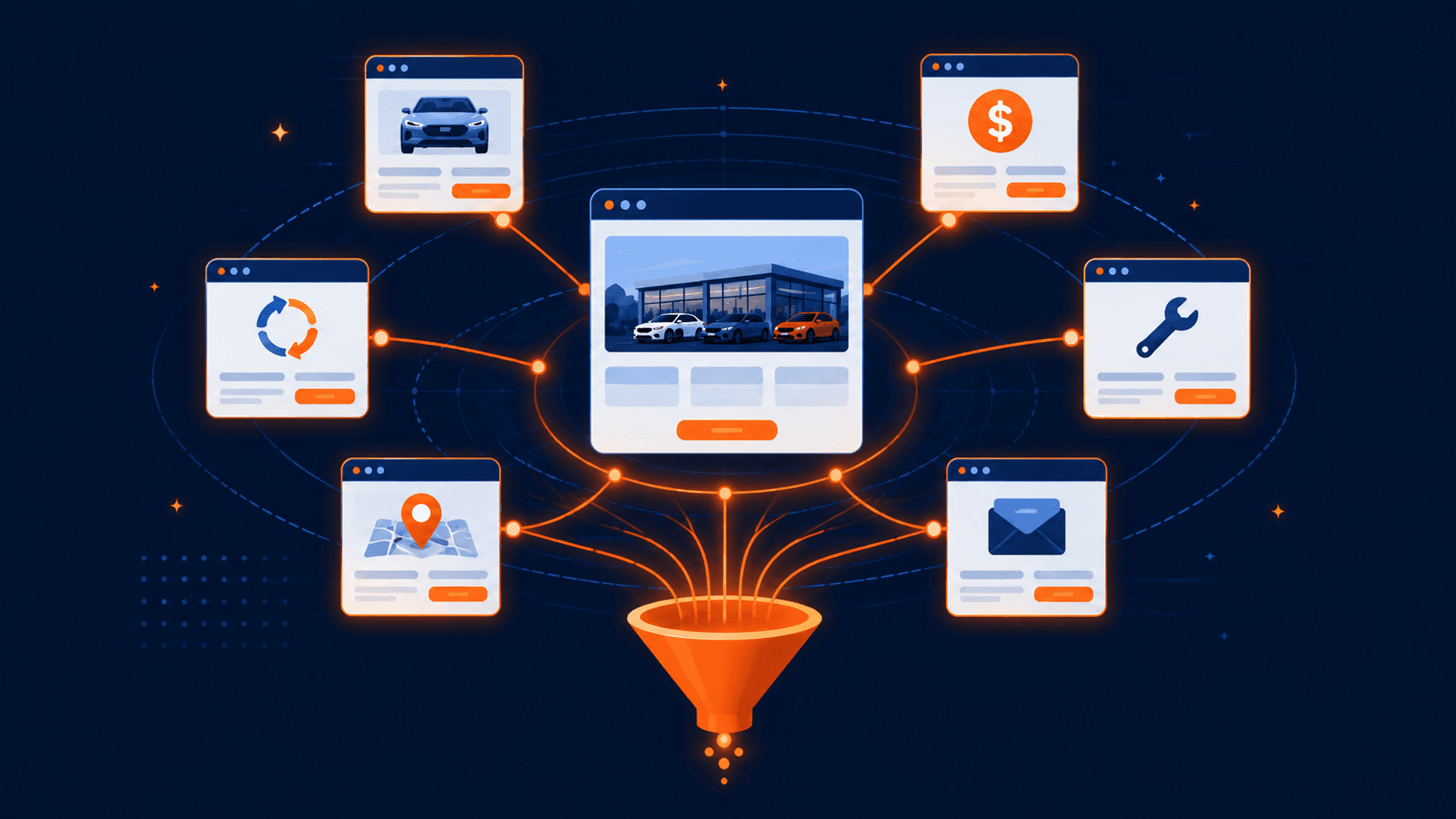
The homepage should explain who the dealership serves
The homepage is often the strongest brand page. It should tell visitors what kind of dealership they found, where the business operates, what makes the offer trustworthy, and what action to take next. Many dealership homepages fail because they try to show everything at once. From an SEO and conversion view, the homepage should route people into the right path: inventory, financing, trade-in, service, or direct contact.
For AI visibility SEO, the homepage also helps define the entity. Search engines and answer engines need to understand the business name, category, location, services, proof, and audience. Clear language matters. If the homepage is vague, the rest of the site has to work harder to explain the dealership.
Inventory pages should match buyer language
Inventory SEO is not only about listing vehicles. Buyers search in different ways: used trucks near me, affordable SUVs, Toyota Tacoma for sale, cars under a certain budget, bad credit car lots, or dealership financing. If the site has inventory pages that can be crawled, understood, and internally linked, those pages can support more specific search demand.
A good inventory or category page should include useful text, not just filters and cards. The copy does not need to be bloated, but it should explain what the buyer can find, what to do next, and how to contact the dealership. Internal links from blog articles, financing pages, and vehicle category pages can help buyers and crawlers move through the site.
Why marketplace exposure does not replace owned dealership SEO
A dealer can still use marketplaces, lead vendors, directories, or inventory platforms and still need its own SEO work. Platforms like CarGurus or CarsDirect can help with exposure inside their ecosystem, and AutoLeadPro-style lead providers can support scaled lead distribution. That does not mean they fix the dealership's owned website, page structure, lead capture path, or Google Search Console opportunities.
This matters most for independent dealers and small lead providers. A large platform is usually built to serve many dealers at once. Jerome SEO Works is positioned differently: the work is hands-on and specific to the site's pages, search data, proof assets, forms, and follow-up workflow. If the issue is owned visibility, weak revenue pages, or missing context after a lead submits, a scale-first platform is solving a different problem.
That is why the best dealership SEO plan should not start by asking only, "where can we get listed?" It should ask, "what does our own site clearly explain, what pages can buyers find, and what happens after they contact us?" If those questions are messy, the site needs a custom page and lead-path review before another generic content push.
Finance and trade-in pages answer high-intent questions
Finance and trade-in searches usually come from buyers who are closer to action. They may not be ready to call yet, but they want to know if the dealership can help them. These pages should answer practical questions: can I apply online, does credit matter, what information is needed, how long does it take, and what happens after I submit the form?
This is where dealership SEO connects directly to lead quality. If the page explains the next step and the form captures the right details, the sales or finance team receives a better lead. If the page only says contact us, the buyer may leave or submit a weak inquiry with no context. That handoff is why SEO work often needs to connect with a dealer lead generation system instead of stopping at rankings.
Service pages support local search and retention
Service pages are easy to ignore when the main goal is vehicle sales, but they can support local visibility and customer retention. A dealership that handles maintenance, repairs, parts, or inspections should make those services easy to find. Service pages can target appointment intent and create another reason for local buyers to return to the site.
The content should be specific enough to be useful. A service page should mention what is offered, who it is for, where the dealership serves, how scheduling works, and what the customer should bring or expect. It should also link back to the main dealership SEO and lead capture paths where relevant.
Connect every SEO page to lead flow
A page that ranks but does not guide the buyer is still leaking opportunity. Each priority page should have a clear form, call path, internal link, or next step tied to buyer intent. The next step should match the page. Inventory pages may push vehicle inquiries. Finance pages may push prequalification. Trade-in pages may push valuation forms. Service pages may push appointment requests.
Buyer behavior supports the page-mapping approach: in Cox Automotive's 2025 Car Buyer Journey Study (2,300 recent buyers, fall 2025), 63% said an omnichannel mix of online and in-store steps would be ideal, and buyers who completed more steps online reported higher satisfaction and less time in store. The dealership pages that support those online steps - inventory, financing, trade-in - are exactly the pages worth SEO investment.
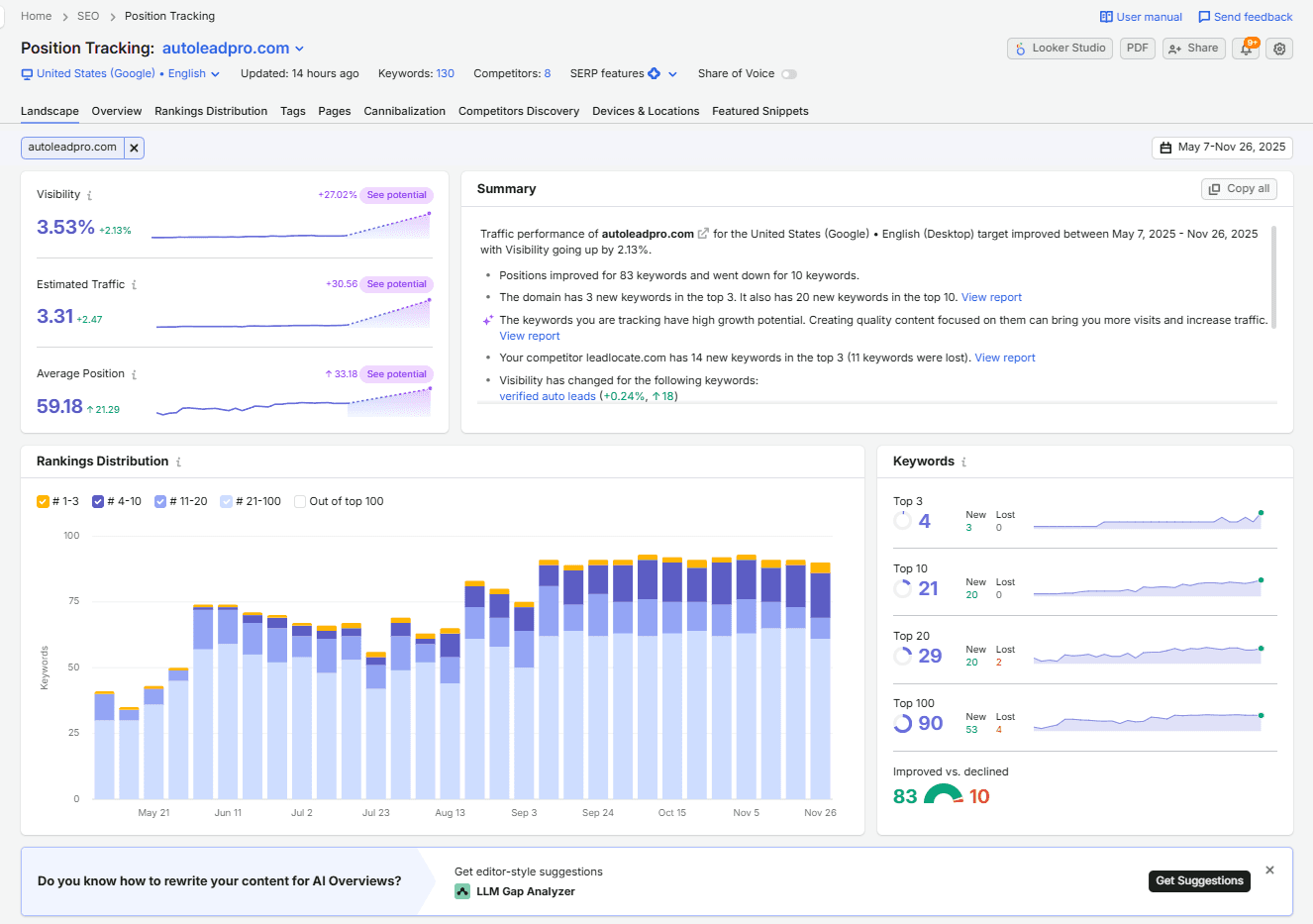
This is also why reporting should not stop at rankings. Google Search Console can show impressions, clicks, queries, and pages. GA4 can help review traffic behavior. Semrush can help review visibility and keyword direction. But the practical question is still this: did the right pages become easier to find, and did those pages help create better lead opportunities?
If impressions are not becoming leads, look for the break
One of the most useful dealership SEO questions is not "do we rank?" It is "where does the buyer lose confidence or direction?" A page can earn impressions and clicks but still fail because the offer is vague, the form asks the wrong questions, the next step is hidden, the inventory path is weak, or the page does not explain why the dealer should be trusted.
For example, a finance page may get visits from buyers with high intent, but if it does not explain approval steps, required information, response time, or what happens after submission, the buyer may not complete the form. A trade-in page may get search interest, but if it only says "contact us" without asking for vehicle details, the lead arrives weak. This is where SEO needs to connect naturally to dealer lead generation.
The fix is not always more traffic. Sometimes the fix is better page intent, better form context, clearer CTAs, and a lead flow that gives the team enough information to respond. That is the difference between ranking pages and revenue-supporting pages.
Use real data to decide what comes first
The order of work should come from evidence. Google Search Console can show which queries and pages already have impressions. GA4 can help show which pages people visit and whether they continue toward conversion. Semrush can give broader visibility and competitor context. Together, those tools help separate pages with real opportunity from pages that only sound important.
A useful review looks for pages with impressions but weak clicks, pages with traffic but poor lead paths, missing pages for high-intent questions, and pages that compete with each other for the same topic. For Jerome SEO Works, proof assets like GSC, GA4, Semrush, and AI visibility screenshots are not decorations. They are there to support decisions about what to fix next.
This is also where a smaller operator can be useful. A large marketplace or lead platform may show its own performance, but it usually will not sit inside an independent dealer's website and map the exact page, search, form, and follow-up problem. If that is the gap, a dealership SEO audit is more practical than guessing from a generic dashboard.
What to do after mapping the pages
Once the page map is clear, the next step is to decide which pages deserve work first. For some dealerships, the priority is technical cleanup and page structure. For others, it is inventory, financing, trade-in, or lead capture. That is the practical reason I treat dealership SEO as part of a broader lead path rather than a detached content checklist.
The next step after mapping pages is to review real data. That means checking Google Search Console for queries and pages, looking for pages with impressions but weak clicks, finding pages with traffic but poor lead paths, and identifying missing pages for high-intent questions. Once those gaps are clear, the site can be improved in a focused way instead of publishing content just to look active.
If your dealership already has traffic but the pages are not creating useful inquiries, start with a focused dealer SEO audit instead of publishing more disconnected content.
FAQ
The pages closest to revenue: homepage, inventory and category pages, financing, trade-in, service, location pages, and lead capture paths. They match buyer intent, convert traffic, and give supporting content something worth linking to.
Yes - in Cox Automotive's 2025 Car Buyer Journey Study, 63% of 2,300 surveyed buyers said an omnichannel approach (online steps plus in-store) would be ideal, and buyers who did more online reported higher satisfaction and less time at the dealership.
Only in support of revenue pages. Generic articles that never route readers toward inventory, financing, or trade-in paths earn impressions without producing inquiries - map pages to buyer intent first, then add supporting content.
Evidence order: Google Search Console pages with impressions but weak clicks, high-traffic pages with weak lead paths, and missing pages for high-intent questions. Fix templates before individual pages.
Sources
- Cox Automotive 2025 Car Buyer Journey Study - Fall 2025 survey of 2,300 consumers who purchased a new or used vehicle in the prior 12 months.