AI Visibility SEO for Dealerships: What Actually Matters First
AI visibility SEO does not replace classic SEO. It adds more pressure to make your dealership easier to understand, cite, and trust.
AI visibility SEO is about making a business easier for search engines and answer engines to understand, summarize, and trust. For dealerships, that starts with clarity, not tricks. A dealership that wants to appear in AI-assisted discovery needs the same foundation that helps normal SEO: clear pages, useful answers, strong internal links, crawlable content, structured data, and proof that the business is real.
AI visibility SEO does not replace dealership SEO
The most important thing to understand is that AI visibility SEO does not replace dealership SEO. It adds another layer. Search engines, AI answer tools, and discovery surfaces still need content they can crawl and interpret. If the dealership site has weak pages, unclear offers, missing internal links, thin content, or poor technical basics, AI visibility will also be weak.
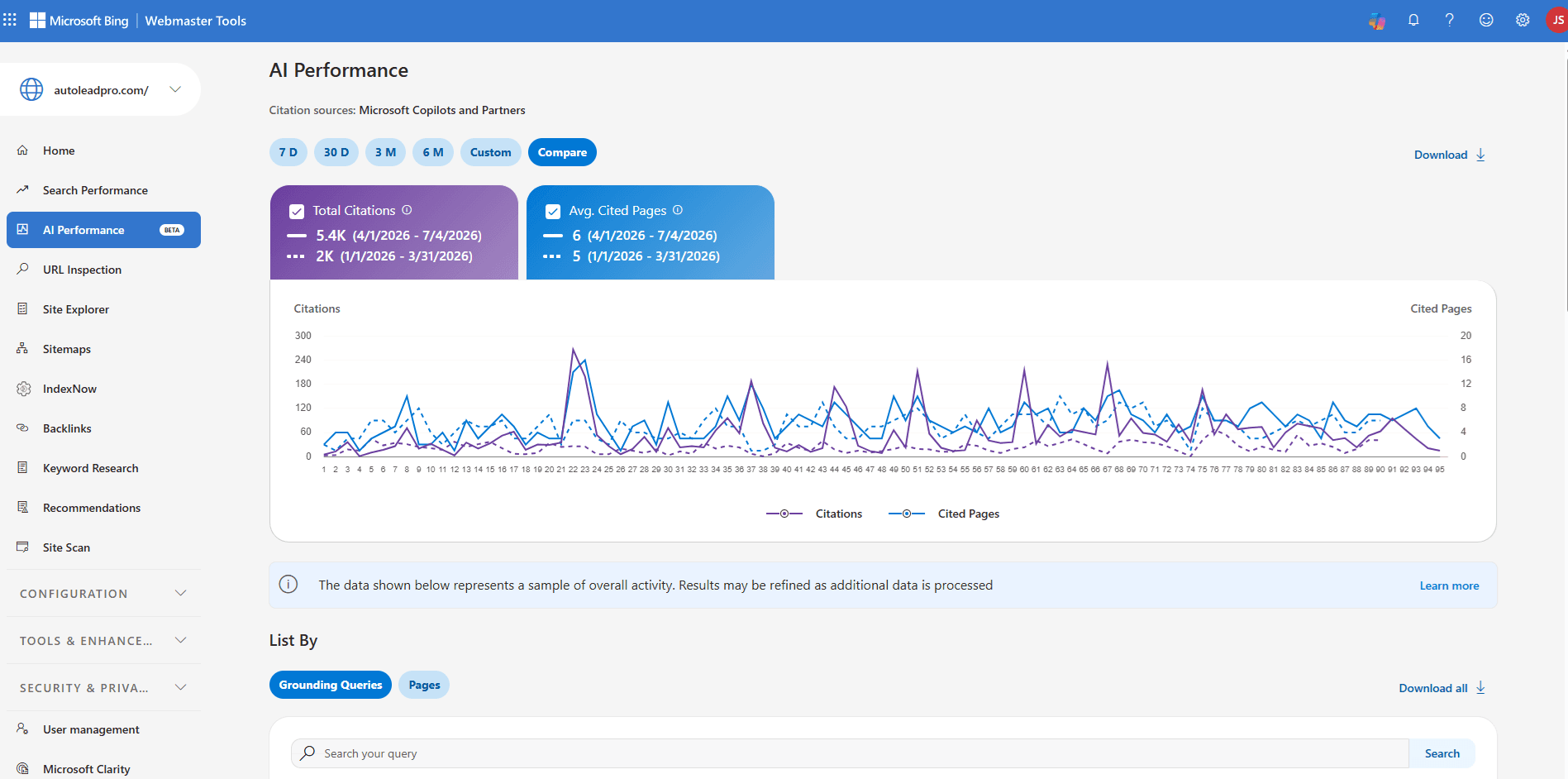
This layered approach is measurable on a live site: on AutoLeadPro.com, the clarity and structure work documented in the public case study coincided with Bing Webmaster Tools recording AI citations growing from 2K to 5.4K (+170%) across a three-month comparison window, with average cited pages per query rising from 5 to 6. No tricks were involved - the same revisions that improved normal rankings raised citation volume.
That means the first step is not chasing every new AI trend. The first step is making the dealership easier to understand. Who does it serve? What vehicles or services does it offer? Where does it operate? What makes it trustworthy? What should a buyer do next? These questions matter for human buyers, Google, and AI systems, which is why AI visibility work should sit beside practical dealership SEO instead of replacing it.
Clarify the dealership entity
The site should make it obvious who the dealership serves, what vehicles or services it offers, where it operates, and what proof supports the business. Entity clarity helps search engines connect the brand to the right category, location, services, and buyer intent. A vague dealership site forces systems to guess. A clear site gives them structured context.
Entity clarity can show up in simple ways: consistent business name, clear service area, dealership category, vehicle focus, contact information, about page, service pages, schema, social profiles, and proof assets. For Jerome SEO Works, the same idea applies to auto lead providers. The site should explain the business model and who it helps so both users and search systems can place it correctly.

Marketplace authority does not clarify your owned site
Large automotive marketplaces can show up often because they have scale, inventory depth, domain authority, and years of structured content. That does not mean an independent dealership's own website is clear. A marketplace page may answer the marketplace's question: what listing is available inside its ecosystem? Your dealership site has a different job. It has to explain who you are, where you operate, what buyers can do next, and why the buyer should trust your process.
This is the part a scale-first platform usually will not solve for you. CarGurus, CarsDirect, or a lead distribution provider can support exposure, but they do not usually sit inside your owned website and rewrite unclear service pages, map internal links, improve schema, or connect your content to your follow-up workflow. That is why AI visibility work should start with owned clarity before chasing mentions on every new AI tool.
Answer buyer questions directly
- What vehicles are available?
- Can buyers finance or trade in?
- Where is the dealership located?
- What happens after a form is submitted?
- Why should a buyer trust the dealership?
Answer engines tend to reward pages that answer questions directly. That does not mean every page should become a giant FAQ wall. It means important pages should include clear answers to questions buyers already have. A financing page should answer financing questions. A trade-in page should explain the process. An inventory page should help buyers understand what is available and what to do next.
This is also useful for conversion. Buyers do not want to decode vague marketing language. They want to know if the dealership can help them, what the next step is, and whether the business looks trustworthy. AI visibility SEO and conversion writing overlap here because both reward clarity.
For a dealership, the strongest AI visibility questions are usually not fancy. They are the practical questions buyers already ask before calling: what vehicles are available, can I finance, can I trade in, where are you located, how fast will someone respond, what documents are needed, and what happens after I submit the form? If the site answers those questions clearly, the content becomes more useful for people and easier for answer engines to summarize.
The same idea applies to lead providers. A lead provider site should explain the audience, lead types, routing process, quality checks, delivery method, and next step. If that information is hidden or vague, AI systems have little reason to treat the site as a clear source. A stronger answer path also helps dealer lead generation because buyers understand what they are submitting and what happens next.
Use schema, but do not rely on schema alone
Structured data can help search systems understand pages, but schema is not a magic ranking button. It works best when the visible page already supports the same meaning. A service page can use Service schema. A blog post can use Article schema. FAQs can use FAQPage schema. Breadcrumbs can clarify site structure. But the content still needs to be useful and honest.
For a dealership or lead provider, structured data should support the real site architecture. The homepage, service pages, blog cluster, proof pages, and contact page should all make sense together. If schema says one thing and the visible page says almost nothing, the page is still weak.
Schema is best used as confirmation, not camouflage. If a page claims to be about dealership financing, the visible copy should answer financing questions. If a page uses Article schema, the article should have a real headline, date, author, description, and useful body content. If a service page uses service or FAQ structure, the service should be explained in plain language. The markup helps machines read what is already true on the page.
Keep the classic SEO foundation
Technical SEO, useful pages, internal links, schema, Google Search Console review, and clear lead paths still matter. AI visibility should support that foundation, not distract from it. A dealership still needs pages that load, crawl, answer intent, and guide buyers. AI search does not make those basics optional.
Internal links are especially important for a cluster strategy, but they should feel useful in the sentence. When a buyer-intent question points toward a service, the article should naturally send the reader to the page that solves it. For this topic, the deeper service explanation lives on the AI visibility SEO page, while the classic SEO foundation still connects back to dealership SEO.
Classic SEO also gives you measurement. Google Search Console can show query and page movement. GA4 can show whether visitors continue toward conversion. Semrush can help monitor broader visibility. AI visibility checks can sit beside those signals, but they should not replace them. The work becomes more believable when it is tied to observable page improvements instead of vague AI promises.
Write for questions, comparisons, and next steps
Dealership buyers often search in question form even when they do not type a perfect keyword. They may want to know which dealer has financing, how trade-ins work, what documents are needed, whether a vehicle is available, or how fast someone will respond. AI-assisted search makes those question patterns even more important because answer engines try to summarize the best available explanation.
A dealership site can support this by publishing pages that answer practical questions without hiding the next step. For example, a finance page can explain approval steps and link to a form. A trade-in page can explain how valuations work and collect vehicle details. A service page can answer appointment questions and link to scheduling. The content should be helpful enough to answer the question and commercial enough to move the buyer forward.
This is where AI visibility SEO becomes useful for lead generation. The page is not only trying to win a blue link. It is trying to become a clear source that can be understood, summarized, cited, and trusted. The more directly the site explains its services, proof, process, and next steps, the easier it becomes for both humans and systems to understand why the dealership is relevant.
Add proof where possible
Proof helps both humans and search systems. For a dealership, proof can include reviews, inventory quality, service details, real photos, location information, process explanations, and case studies. For Jerome SEO Works, proof includes Google Search Console screenshots, GA4 views, Semrush visibility, AI visibility assets, sample dealership pages, and system dashboard examples.
The important part is not pretending. AI visibility SEO should not create fake authority. It should organize real authority. If the business has real work, real services, real examples, and real answers, the site should make that evidence easy to find.
Proof can be simple at first. Use real photos, service explanations, review language where allowed, screenshots of performance tools, sample landing pages, case studies, and process details. Jerome SEO Works uses assets like AI visibility proof, Semrush proof, GSC screenshots, and the live contact flow because those items support the claim that the work is practical. The same proof mindset should guide dealership pages.
How to measure AI visibility without selling hype
AI visibility is still changing, so it should be measured carefully. I would not promise that a dealership will appear in every AI answer. A better approach is to track whether the site becomes clearer, more complete, better linked, better structured, and easier to cite. Then compare that work with GSC movement, Semrush visibility, GA4 behavior, and manual checks in AI-assisted search surfaces.
The honest question is not "did one AI tool mention us today?" It is "can search and answer systems understand the business better than they could before?" If the answer is yes, the site is moving in the right direction. If the pages are still thin, vague, or disconnected, the next step is not another shortcut. It is a focused AI visibility SEO audit tied to real page improvements.
Where AI visibility fits in the full SEO system
AI visibility fits best as an added layer on top of classic SEO, proof, and lead-focused page structure. If your dealership or lead provider site is unclear, the first work is usually entity clarity, direct answers, schema opportunities, internal links, and proof assets. The AI visibility SEO service page lays out that audit path in more detail.
A practical AI visibility SEO workflow starts with an audit. Review the important pages, identify unclear offers, add missing answers, improve internal links, structure service pages, add schema where appropriate, and track classic SEO signals alongside available AI visibility proof. This creates a stronger foundation for both search engines and answer engines.
Jerome SEO Works treats AI visibility SEO as an added layer on top of practical dealership SEO and proof-led content. The goal is not to chase hype; the goal is to make the business easier to understand, trust, and choose. If that is the gap on your site, request an AI visibility review.
FAQ
Making the dealership easier for search and answer engines to understand, summarize, and trust: clear entity signals, direct answers to buyer questions, structured data that confirms the visible page, and proof assets - layered on top of classic SEO, not replacing it.
Yes - Bing Webmaster Tools reports AI citations directly. On AutoLeadPro.com, citations grew from 2K to 5.4K (+170%) in a three-month comparison, with cited pages rising from 5 to 6 - documented with screenshots in the public case study.
It helps only as confirmation. Structured data lowers the machine's cost of trusting what the visible page already says; markup wrapped around thin content changes nothing.
No. Owned clarity comes first - if the site's pages are vague, no amount of AI-tool chasing fixes it. Improve entity clarity, direct answers, internal links, and proof, then verify movement in the platforms you can measure.
Sources
- AutoLeadPro case study - Jerome SEO Works - Live client proof: Bing Webmaster AI citation growth from 2K to 5.4K (+170%) in a 3-month comparison, with platform screenshots.