Best Lead Follow-Up System for Car Dealerships
43.2% of dealership website leads are mishandled, and 14.1% never reach a CRM at all. The best follow-up system is the one that closes those specific gaps - not the biggest platform.
According to Foureyes' 2025 Automotive Dealer Industry Benchmarks Report - released in March 2025 and based on 1.1 billion dealer website visits across 22,500 dealership websites during calendar year 2024 - 43.2% of dealership website sales leads were mishandled, and 14.1% never got logged to the dealer's CRM at all. That is the real scale of the follow-up problem: nearly half of the leads dealerships already paid to generate leak out of the process after they arrive.
So the question 'what is the best lead follow-up system for a car dealership' is really asking: which system closes those specific leaks? This post answers that with industry data from three independent sources - a website analytics study, a mystery-shop study, and a consumer survey - plus the workflow I run in production for an automotive lead provider.
Is it a lead quality problem or a follow-up problem?
This is the moment of confusion where most dealers actually live: 'we pay for leads and nobody answers the phone - are the leads bad, or are we?' The data says check the follow-up first. Foureyes' 2025 analysis found the mishandling rate varies by channel - 47.7% of website phone calls, 42.2% of form fills, and 35.5% of chats were mishandled in the 2024 data. Those are leads the dealership's own website generated, from buyers who chose to reach out. Before concluding the leads are weak, you need proof your process could have converted strong ones.
Why 'we respond fast' and 'leads get mishandled' are both true
Here is a conflict in the industry data worth understanding, because both sides are accurate. DAS Technology's Automotive Lead Response Study - unveiled at NADA 2025 in New Orleans, based on 1,700 lead inquiries submitted through dealership vehicle detail pages in Q3-Q4 2024 - found dealers are improving: 61% responded within 15 minutes, up from 55% in 2022. Meanwhile Foureyes reports 43.2% of leads mishandled in the same period. Contradiction? No - they measure different windows.
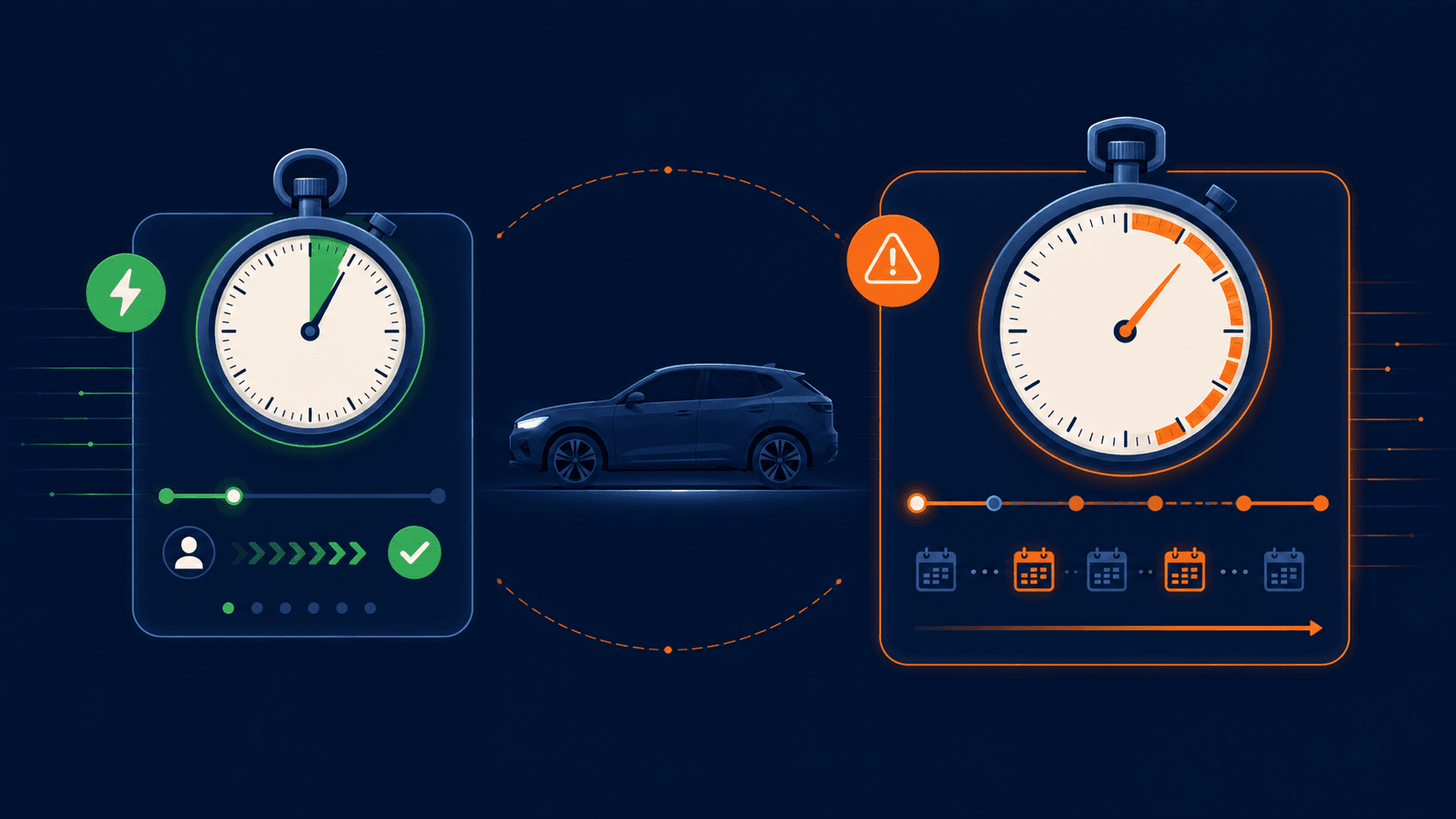
DAS measures speed-to-first-response on a brand-new inquiry. Foureyes measures handling across the full sales cycle - including whether the lead ever reached the CRM and whether anyone followed up when the buyer came back. A dealership can answer the first form fill in ten minutes and still lose the same buyer two weeks later: Foureyes found that when a lead returned to the website after already submitting, 65% did not hear back from the dealer within 24 hours of that return visit, and 61.6% were not contacted until eight or more days later. First-touch speed has improved. Everything after the first touch is where the system is still broken - and that is exactly the part a follow-up system exists to fix.
What the smallest useful system must have
A small dealership does not need an enterprise CRM on day one. It needs the smallest system that closes the measured gaps: every lead becomes a record, every record has an owner, and every owner can see what to do next.
- A record for every lead, created automatically - the Foureyes finding that 14.1% of leads never reach a CRM is a capture failure, not a selling failure.
- An owner on every record - a lead that belongs to everyone belongs to no one.
- A status vocabulary the team actually uses: new, contacted, waiting, appointment, sold, lost.
- Source and intent preserved - finance requests and trade-ins need different first responses.
- A return-visit trigger or re-contact reminder - the 8-plus-day silence Foureyes measured on returning buyers is pure lost revenue.
This is the point where most advice says 'buy a CRM.' My experience running this in production says the tool matters less than the wiring. Jerome SEO Works builds the follow-up layer as a routing system: every inbound reply is parsed, categorized by intent, and assigned to its owning dealership automatically - the BlinkVoice-webhook-to-Google-Sheets pipeline documented on the builds page - which is what makes same-hour human response realistic for a small team without hiring anyone.
The first response: automate the confirmation, not the conversation
A useful auto-reply confirms receipt and sets the next expectation - it does not pretend to be a salesperson. DAS Technology's NADA 2025 study also graded response content, and the gaps were striking: 91% of dealer responses excluded payment details, 90% omitted multiple photos, and 74% did not offer a price quote. Speed without substance just moves the disappointment earlier. The human follow-up that comes after the confirmation is where the answers belong - and the system's job is to make sure that human arrives fast, with the lead's context already attached.
Follow-up has a longer tail than most dealers work
Foureyes' 2025 report found 40% of buyers still purchase after day three of the sales cycle - which means a follow-up cadence that quits after two attempts abandons a large share of real buyers. This matches the satisfaction side: Cox Automotive's 2025 Car Buyer Journey Study - a fall 2025 survey of 2,300 consumers who purchased a vehicle in the prior 12 months - recorded 76% overall buyer satisfaction with dealerships, near the record high, and identified idle and waiting time as the top friction point in the purchase experience. Buyers reward dealerships that respect their time across the whole journey, not just at the first hello.
- Day 0: instant confirmation + same-hour human response on interested leads.
- Day 1-3: answer the actual question (payment, photos, availability) - the content DAS found missing in 74-91% of responses.
- Day 4-14: scheduled check-ins tied to the buyer's stated timeline - 40% of purchases happen in this window or later.
- Return visit at any point: alert and same-day re-contact - the gap where 65% of dealers currently go silent.
Measure the system, not the vibes
Two numbers tell you whether follow-up is working: time-to-first-human-response on interested leads, and percentage of leads with a logged owner and status. If you can also track re-contact time on return visits, you are measuring the exact failure modes the industry data documents. Everything else - dashboards, reports, integrations - exists to serve those numbers. That measurement-first mindset is the same one behind the validation stage of my SEO process: movement gets proven in data, or the work is not done.
If your dealership is losing leads inside email, spreadsheets, or disconnected tools, start with a focused CRM lead funnel review before buying another platform. The gaps are measurable - and most of them are wiring, not headcount.
FAQ
43.2% of dealership website sales leads were mishandled according to Foureyes' 2025 Automotive Dealer Industry Benchmarks Report, based on 1.1 billion dealer website visits across 22,500 dealership websites in calendar year 2024 - and 14.1% of leads never reached the dealer's CRM at all.
61% of dealerships responded to a website lead within 15 minutes in DAS Technology's Automotive Lead Response Study (1,700 dealership inquiries, Q3-Q4 2024, presented at NADA 2025) - up from 55% in 2022, while 19% still took over an hour.
The smallest system the team will actually use: automatic lead capture into a record, an owner on every lead, a simple status vocabulary, and reminders on return visits. A structured Google Sheet with automated input can outperform an unused CRM - the deciding factor is automatic capture, since 14.1% of leads never reach a CRM when entry is manual (Foureyes, 2025).
At least two weeks, with return-visit triggers running longer. Foureyes' 2025 report found 40% of buyers purchase after day three of the sales cycle, while 61.6% of returning website leads were not re-contacted until eight or more days later - a gap between buyer behavior and dealer behavior that persistent follow-up captures.
Automate the plumbing, not the conversation: instant confirmations, lead capture, categorization, routing to the right store or desk, and reminders. Keep the actual buyer conversation human - DAS Technology's NADA 2025 study found most dealer responses already lack substance (74% offered no price quote), which automation alone does not fix.
Yes - through the buyer's time. Cox Automotive's 2025 Car Buyer Journey Study (2,300 buyers surveyed in fall 2025) recorded 76% overall satisfaction and identified idle and waiting time as the top friction point in the purchase process; follow-up that answers questions quickly directly reduces the friction buyers penalize dealerships for.
Sources
- Foureyes 2025 Automotive Dealer Industry Benchmarks Report - Released March 2025. Analysis of 1.1 billion dealer website visits and 30 million inventory pieces across 22,500 dealership websites, calendar year 2024. Key findings used: 43.2% of leads mishandled, 14.1% never logged to CRM, 65% of returning leads not contacted within 24 hours, 40% of buyers purchase after day three.
- DAS Technology Automotive Lead Response Study (NADA 2025) - Unveiled January 2025 at NADA in New Orleans. Mystery-shop study of 1,700 lead inquiries submitted through dealership vehicle detail pages, Q3-Q4 2024. Key findings used: 61% responded within 15 minutes (up from 55% in 2022), 19% took over an hour, 74% offered no price quote, 91% excluded payment details.
- Cox Automotive 2025 Car Buyer Journey Study - Fall 2025 survey of 2,300 consumers who purchased a new or used vehicle in the prior 12 months. Key findings used: 76% overall dealership satisfaction (near the 77% record), idle/waiting time identified as the top friction point.